Client work · Front-end · 2023 — 2025
Diego Web Studio
An independent practice where design, build, and delivery are the same job.
- Role
- Founder, designer, developer
- Timeline
- 2023 — 2025
- Team
- Solo practice with client collaborators
- Tools
- Figma, Notion
- Responsibilities
- Discovery, Design, Development, Deployment
- React
- Next.js
- Tailwind
01 / Practice model
One practice, from first conversation to live website.
Diego Web Studio is an independent design-and-build practice. The responsibility spans discovery, interface design, development and deployment, with clients contributing business context and feedback.
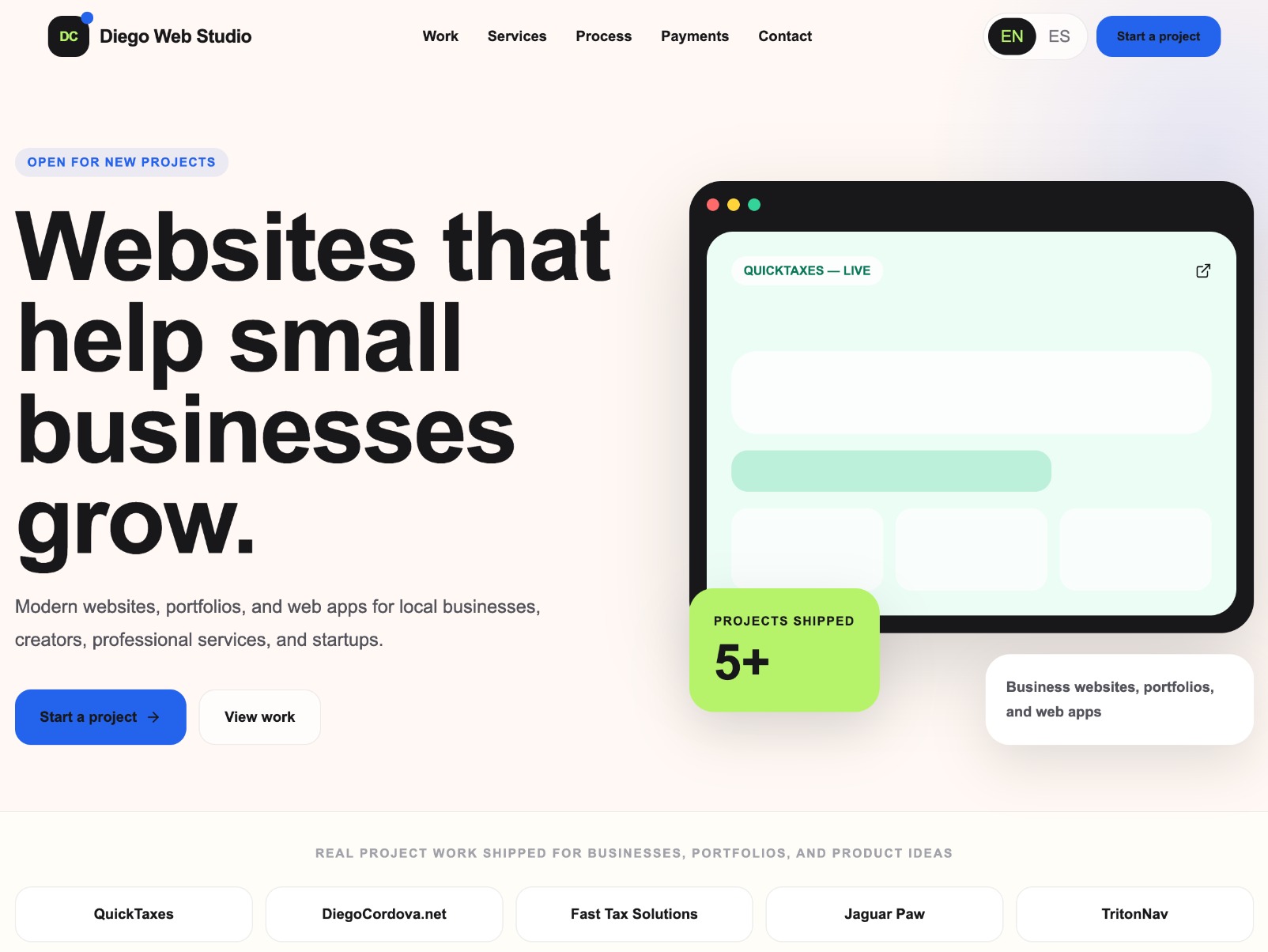
The homepage makes the offer concrete through a live-project preview and a row of portfolio references. This case study does not turn the screenshot's promotional copy into revenue, traffic or conversion claims.
02 / Connected process
Less handoff. More continuity.
Discovery frames what the business needs visitors to understand and do. Design turns that brief into hierarchy and interaction decisions; implementation tests whether those decisions work beyond a static composition.
Deployment is part of the practice, not an afterthought. Client review and the constraints exposed by shipping feed the next iteration. This is a process model, not a claim that every project followed identical stages or timing.
- 01
Discover
Clarify the offer, audience, constraints and primary action with the client.
- 02
Design
Shape page hierarchy, content and interactions into a coherent interface.
- 03
Implement
Build the experience in React, Next.js and Tailwind as appropriate.
- 04
Deploy
Take the reviewed implementation into a live web environment.
- 05
Learn
Use client feedback and implementation discoveries to refine the next pass.
03 / Portfolio as proof
Show the work, not just the offer.
The studio screenshot presents a QuickTaxes live-project preview alongside a direct start-a-project action. The client-project row connects the practice to tangible web work without requiring an invented dashboard of business results.
The portfolio itself becomes a communication problem: visitors need to distinguish what the practice offers from the evidence of what it has delivered. Clear project labels and a readable introduction help maintain that separation.
04 / Learning from shipping
Implementation changes the design conversation.
Owning design and development keeps content, layout and technical constraints in the same feedback loop. Client collaboration makes the brief concrete; building makes edge cases visible; deployment creates an experience that can be reviewed in use.
The supported outcome is an independent practice delivering client web work. A next step is to document project-specific review criteria and post-launch observations so future case studies can distinguish design intentions from measured outcomes.