Research · Cognitive Science · 2025
Memory & Cognition Research
How precise is visual memory? A two-choice browser experiment shows a descriptive gradient between recognizing objects and distinguishing their exact state.
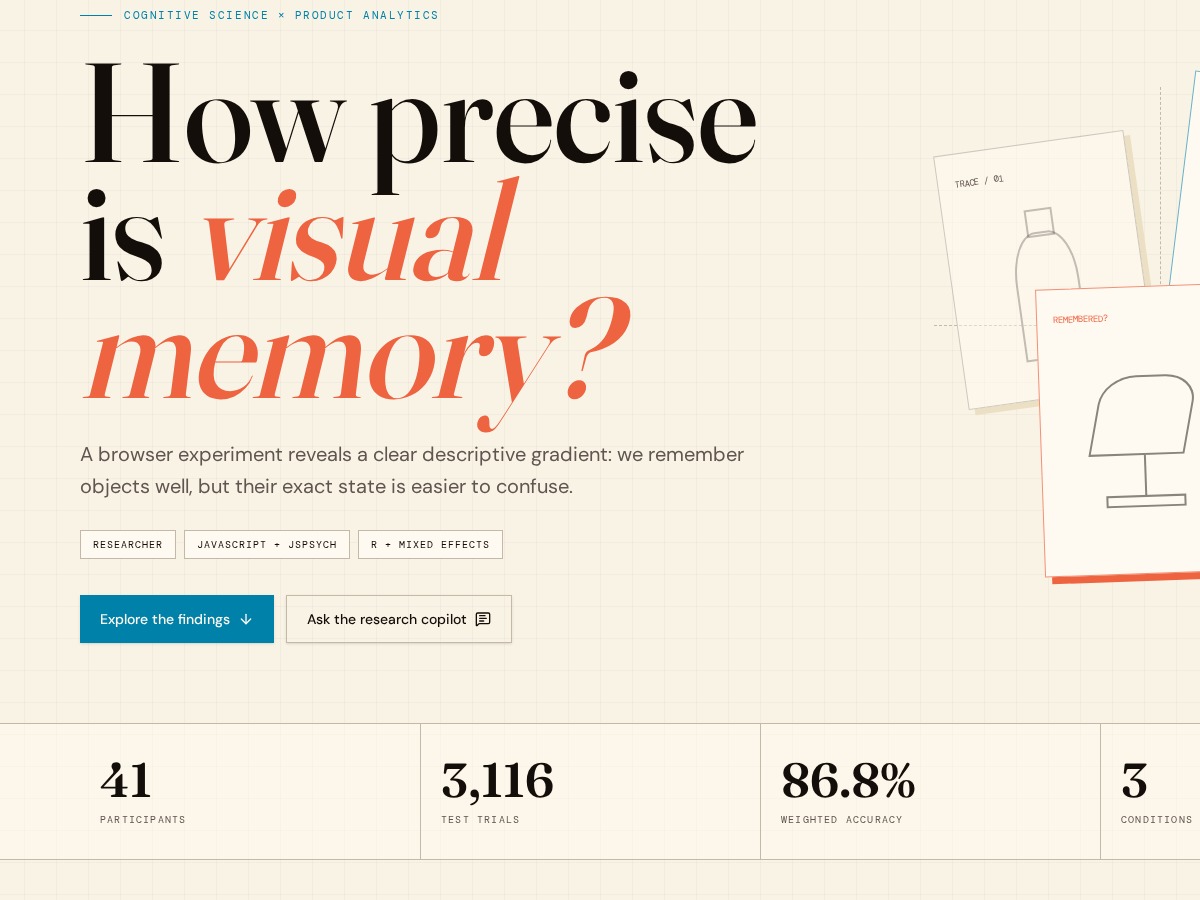
- 41
- Participants
- 6,437
- Processed rows
- 3,116
- Test trials
- 86.8%
- Condition-weighted accuracy
Academic group project · Study design, analysis and write-up · JavaScript / jsPsych / R / tidyverse / lme4. Exact collaborator roles and collection dates are not established here.
01 / Research question
Recognizing an object is not the same as remembering its exact state.
How precise is visual recognition memory when a familiar object must be distinguished from a novel object, another exemplar, or another state of that object? The experiment separates these comparisons rather than treating recognition as a single score.
02 / Method
A browser-based, two-choice recognition task.
Participants study object images, then choose between two alternatives at test. Novel, Exemplar and State comparisons vary the distinction required. Accuracy and response time provide complementary descriptive measures; chance in a two-choice task is 50%.
- 01
Study object images
- 02
Choose the studied alternative
- 03
Record correctness and response time
Controls built into the task
- Randomized study and test order
- Counterbalanced studied pair member
- Five delayed repeat attention checks
- Preloaded images
- Randomized left/right answer position
Attention checks are task controls, not an undocumented exclusion rule. The processed-row count includes more than test trials; it is not a second sample-size estimate.
03 / Condition comparison
A descriptive gradient in recognition precision.
Novel comparisons have the highest observed accuracy, followed by Exemplar and State. State has more trials than either other condition, so the reported 86.8% condition-weighted summary should not be silently replaced with a pooled trial estimate.
Recognition accuracy by condition
Percent correct · two-choice chance = 50%
- Novel
- 95.5%
- Exemplar
- 88.8%
- State
- 80.8%
Median response time by condition
Milliseconds · medians, not means · lower is faster
- Novel
- 1,252 ms
- Exemplar
- 1,428 ms
- State
- 1,530 ms
| Condition | Test trials | Accuracy | Median RT |
|---|---|---|---|
| Novel | 820 | 95.5% | 1,252 ms |
| Exemplar | 820 | 88.8% | 1,428 ms |
| State | 1,476 | 80.8% | 1,530 ms |
- Novel: A studied object versus a new object.
- Exemplar: A studied object versus another exemplar.
- State: A studied object versus a different state.
04 / Analysis pipeline
From browser records to interpretable comparisons.
- 01
Collect
JavaScript and jsPsych present the study and two-choice recognition task in the browser.
- 02
Process
R and tidyverse organize 6,437 processed rows and distinguish the 3,116 test trials from other records.
- 03
Compare
Summarize accuracy and median response time separately for Novel, Exemplar and State trials.
- 04
Evaluate
lme4 supports mixed-effects analysis. The figures here report descriptive summaries, not inferential model results.
05 / Findings & limits
Useful evidence, with a defined boundary.
All three aggregate accuracies are above the numerical 50% chance reference. Novel comparisons are more accurate and faster in these summaries; State comparisons are less accurate and slower. These are descriptive observations, not claims of statistical significance or causal effects.
Unequal condition trial counts, repeated observations within participants, stimulus differences and browser/device timing all matter to interpretation. Aggregated medians hide variation. No confidence intervals, p-values, participant-level distributions or verified exclusion audit are supplied here, so none are implied.
06 / Product & HCI translation
Design for recognition, not perfect recall.
The pattern motivates a design question: when people need to distinguish similar items or changed states, what persistent cues can support them? Clear labels, stable visual references, explicit change indicators and visible history are candidate responses—not outcomes validated by this experiment.
A next HCI study could compare those cues in a realistic task, measuring recognition errors and completion time. This would test the translation rather than assuming that object-memory results automatically generalize to interfaces.
07 / Next steps
Make the uncertainty inspectable.
- Audit participant-level records, missing responses and attention-check handling.
- Report uncertainty and participant/stimulus variation alongside condition summaries.
- Document mixed-effects specifications before making inferential claims.
- Test the proposed interface cues with representative users and tasks.